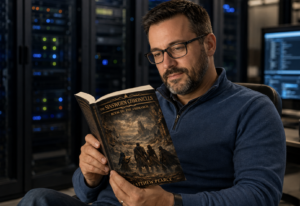
The modern IT professional spends the day inside systems that rarely stay quiet. Software updates arrive without warning, security alerts demand immediate attention, users forget passwords, networks slow down, projects change direction, and new artificial intelligence tools seem to appear every week. Even after the workday officially ends, notifications, unfinished tickets, and tomorrow’s deadlines can continue running in the background of the mind.
That constant digital pressure makes a complete change of scenery especially valuable. For a growing number of technology professionals, relaxation begins by closing the laptop, silencing the phone, and entering a world that operates by swords, ancient loyalties, dangerous roads, and decisions with consequences far greater than another missed software deployment.
The Ashmarch, Book III of The Sinsworn Chronicles by Matthew Pearce, offers precisely that kind of escape. It replaces dashboards with distant horizons, digital threats with tangible enemies, and virtual meetings with a journey through a land shaped by conflict, courage, and sacrifice. For readers searching for good epic fantasy books, The Ashmarch provides a compelling destination after a demanding day in technology. ⚔️
The Technology Industry Never Truly Stands Still
Working in technology requires an unusual combination of concentration, adaptability, and patience. IT professionals are expected to understand the systems currently in place while preparing for technologies that may transform those systems within months. They troubleshoot immediate problems, protect valuable information, support frustrated users, and make decisions that can affect an entire organization.
The scope of the profession is enormous. As the Wikipedia overview of information technology explains, IT encompasses the creation, processing, storage, retrieval, and transmission of information through computer systems and telecommunications. That broad definition includes everyone from help desk specialists and network administrators to software developers, database architects, cybersecurity analysts, and chief information officers.
Demand for these skills continues to rise. The U.S. Bureau of Labor Statistics projects that employment across computer and information technology occupations will grow much faster than the average for all occupations from 2024 through 2034. That growth creates opportunity, but it also brings heavier workloads, faster change, and greater responsibility.
The arrival of generative AI has intensified the pace. Technology teams are being asked to evaluate new platforms, control security risks, develop responsible-use policies, automate processes, and help employees understand tools that are still evolving. A Computerworld report on keeping technology workers engaged described the pressure IT employees face as they try to keep up with rapidly changing technology while managing fears about automation and job security.
When the working day is built around constant change, genuine rest requires more than switching from a business application to a social media feed. The mind needs somewhere entirely different to go.
Why Ordinary Screen Time Does Not Feel Like an Escape
Streaming a show, watching short videos, or scrolling through news can feel effortless, but these activities often continue the same patterns that dominate the workday. The eyes remain fixed on a screen. Information arrives in fragments. Notifications interrupt concentration. Algorithms decide what appears next.
Reading a novel creates a different mental rhythm. A book invites the reader to slow down, picture unfamiliar places, remember characters, interpret motives, and follow a story over time. It replaces rapid digital stimulation with sustained attention.
That transition matters for professionals whose days are divided among tickets, messages, alerts, meetings, and competing priorities. Instead of reacting to an endless stream of incoming information, the reader controls the pace. The story waits patiently when the book is closed and resumes from the same place when the reader returns.
Research also supports recreational reading as a meaningful form of restoration. A study available through the National Library of Medicine found evidence that fiction can positively affect mood and emotion. Another randomized trial examining reading a book before sleep found that a greater proportion of participants in the reading group reported improved sleep quality compared with those who did not read in bed.
The value is not merely the absence of a screen. A satisfying novel gives the mind something rich enough to hold its attention without demanding another solution to a workplace problem.
The Ashmarch Offers a Complete Departure From Digital Life
The best after-work fiction creates distance from the concerns of the day. The Ashmarch carries readers into a dangerous fantasy landscape filled with uncertainty, conflict, and the weight of past choices. Its world has its own history, rules, loyalties, and dangers, allowing the reader to leave familiar routines behind.
This distinction is important for someone who has spent eight or ten hours solving technical problems. A novel about office politics, software failures, or corporate disruption may feel too close to work. The Ashmarch offers another kind of pressure, one grounded in survival, honor, courage, and the bonds formed between people facing a difficult road.
A broken server needs a diagnosis. A cybersecurity incident needs containment. An angry user needs reassurance. The conflicts of epic fantasy operate on a different scale. They unfold through physical landscapes and human choices rather than status reports and service-level agreements.
The contrast makes the escape more effective. Readers can exchange fluorescent offices for a harsh wilderness, email threads for urgent alliances, and technical documentation for a story shaped by mystery and danger. The experience creates emotional distance without becoming empty or forgettable.
Epic Fantasy Rewards the Skills IT Professionals Already Use
Although fantasy offers an escape from technology, it often appeals to the same mental strengths that draw people toward IT careers. Both fields reward attention to structure, logic, patterns, and cause and effect.
A complex technology environment contains connected systems. Changes made in one location may create unexpected consequences somewhere else. Epic fantasy worlds function in a similar way. Political choices affect distant communities. Old rivalries influence present conflicts. A seemingly minor decision can change the direction of a journey.
IT professionals are accustomed to observing details and forming theories before all the facts are available. Those habits make layered fantasy especially engaging. Readers notice clues, track relationships, evaluate motives, and consider how the history of a fictional world may shape what happens next.
The difference is that nothing needs to be repaired before bedtime. The reader can enjoy the complexity without carrying responsibility for the outcome. That balance makes The Ashmarch mentally engaging while still allowing it to serve as an escape.
Technology Burnout Makes Deliberate Downtime Essential
The pressure facing technology workers has become a serious professional concern. A CIO examination of burnout in the IT industry reported significant burnout among technology employees, with the experience varying according to role, organization size, and team structure.
Cybersecurity professionals face particularly intense demands. Their work involves constant vigilance, high consequences, and the knowledge that attackers need only one successful opening. The defender must remain prepared every day. The National Institute of Standards and Technology has addressed the relationship between mental health and cybersecurity work, including the ways stress and fatigue can affect decision-making and professional performance.
Burnout is more than feeling tired at the end of a difficult week. The American Psychological Association’s workplace burnout guidance describes it as an occupational syndrome connected to chronic workplace stress that has not been successfully managed.
A novel cannot remove an unreasonable workload or solve an unhealthy workplace culture. It can, however, become part of a healthier boundary between professional responsibility and personal time. A regular reading ritual sends a clear signal that the workday has ended. The monitor goes dark, the phone moves out of reach, and attention shifts toward something chosen entirely for enjoyment.
A Strong Series Gives Readers Somewhere Familiar to Return
The Ashmarch is the third book in The Sinsworn Chronicles, which gives it an advantage for readers who enjoy becoming invested in a continuing story. A series allows its world to grow deeper with each volume. Earlier conflicts carry forward, relationships gain history, and familiar characters arrive with emotional weight already attached to them.
For busy technology professionals, that continuity can become comforting. Beginning a reading session does not require searching through hundreds of streaming options or learning an entirely new cast of characters every evening. The world is already waiting.
A few chapters can fit naturally between dinner and sleep. Longer reading sessions can fill a quiet weekend morning. Because the experience is self-paced, there is no requirement to finish an episode or remain online until an arbitrary stopping point. The reader decides when to enter the story and when to set it aside.
That freedom is especially appealing in a career governed by schedules, uptime requirements, project milestones, and other people’s emergencies.
The Journey Feels Earned Rather Than Manufactured
Epic fantasy succeeds when its dangers matter and its characters have something meaningful to lose. The genre depends on more than spectacle. Its strongest stories are grounded in human concerns such as loyalty, fear, ambition, grief, identity, and the difficult choices people make when every available path carries a cost.
The Ashmarch belongs to that tradition. Its appeal comes from the sense of entering a world with real weight behind it. The landscape is more than scenery, and the journey is more than movement between two locations. The setting becomes part of the struggle.
This depth gives readers an experience that short digital entertainment rarely matches. An evening spent inside a well-developed fantasy novel can feel substantial. The reader has traveled, witnessed conflict, learned more about the characters, and moved deeper into a story that continues beyond a single sitting.
For someone whose professional life is filled with temporary fixes and rapidly obsolete tools, there is satisfaction in a narrative built to unfold gradually.
Logging Off Becomes the Beginning of an Adventure
Technology professionals do essential work in a field that continues expanding. They keep businesses operating, protect sensitive information, support employees, build new systems, and help organizations navigate constant technological change. Those responsibilities make real downtime increasingly important.
The Ashmarch offers more than a way to fill an evening. It provides a deliberate transition from digital urgency to imaginative immersion. Its world asks readers to follow a dangerous path, care about the people walking it, and leave the machinery of modern work behind for a while.
Conclusion
After a long day of managing systems, responding to alerts, learning new platforms, and solving problems under pressure, the last thing many IT professionals need is another glowing screen demanding their attention. Epic fantasy creates room for a different kind of thought—slower, deeper, and driven by imagination rather than obligation.
The Ashmarch gives readers a place to go when the tickets are closed, the final message has been sent, and the workday is finally over. Logging off no longer marks the end of the day. It marks the entrance to a harsher, stranger, and far more adventurous world. 📖